Cell
Introduction
Earth is populated by a huge diversity of organisms, the number of which is estimated to be in the millions.
Despite this diversity, which is manifested in morphology, behavior, diet, and modes of reproduction, there is one universal trait shared by all organisms; they are all made of cells.
Indeed, the basic cellular structure can be found in:
- Bacteria and yeasts, which are made up of single cells (i.e., unicellular)
- Simple invertebrates that contain several tens of nearly identical cells that all share the same function
- Mammals (including humans), whose bodies contain trillions of morphologically and biochemically distinct cells. These cells are organized hierarchically as tissues and organs, and carry out distinct functions.
Cellular Structure
Why is the cellular structure so important for maintaining life?
There may be several answers to this question, but at the most basic level, the advantage of cells is that they enable the organisms they build to distinguish themselves from the environment.
That is to say, the cellular structure creates an inner environment that differs in its physical and chemical properties from the outer environment.
The manifestation of this distinction is what we call ‘life processes’, i.e., the ability of the cell to extract energy from its environment, build complex materials and degrade waste, grow, divide, move, etc.
Shared characteristics of all life forms:
- A highly organized, dynamic, and complex cellular system of enzyme-catalyzed chemical transformations.
- Ability to extract, transform, and use energy from the environment.
- Self-assembly of simple building blocks into complex molecules and structures.
- Ability to self-replicate.
- Ability to sense and respond to the environment.
- Ability to evolve.
Prokaryotic
Unicellular life forms with prokaryotic cell structures existed as early as 3.2 to 3.8 billion years ago.
Prokaryotic cells are small (~1 μm = 10−6 m) and lack any visible internal organization.
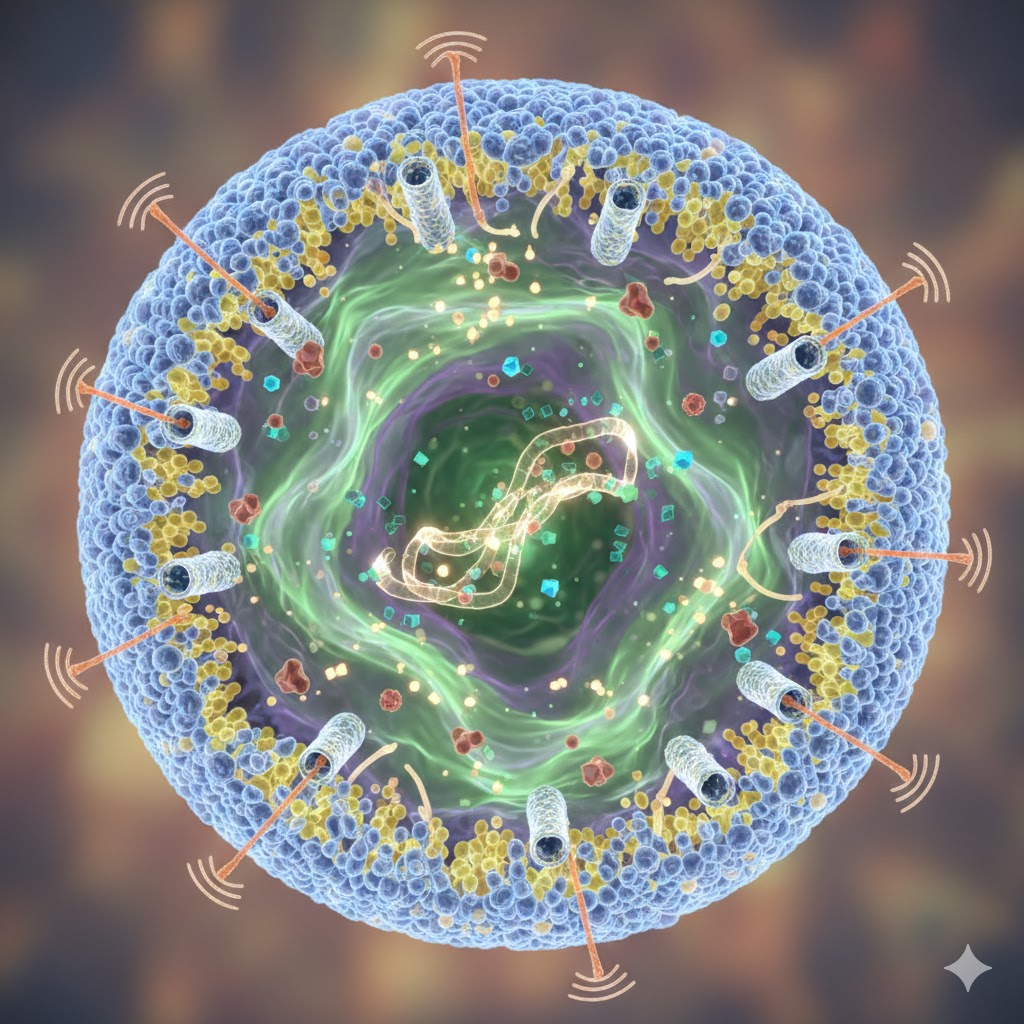
A prokaryotic cell consists of a lipid membrane (the plasma membrane) engulfing an inner aqueous environment (the cytoplasm).
The cytoplasm is where all life processes take place, and it is separated from the external environment of the cell by the plasma membrane.
This separation, however, is not absolute; the membrane selectively allows the uptake of required molecules from the environment into the cell and the excretion of waste products. In addition, the membrane ‘senses’ the outside environment and relays important information into the cell.
Bacteria
The prokaryotic organisms went through many evolutionary cycles of mutations and selection, leading to a morphologically and metabolically diverse collection of bacteria.
Despite these changes, it seems that for 2 billion years or so there was no change in the basic prokaryotic structure of the bacterial organisms populating Earth.
Bacterial cells also have cell walls, which physically protect them from the external environment.
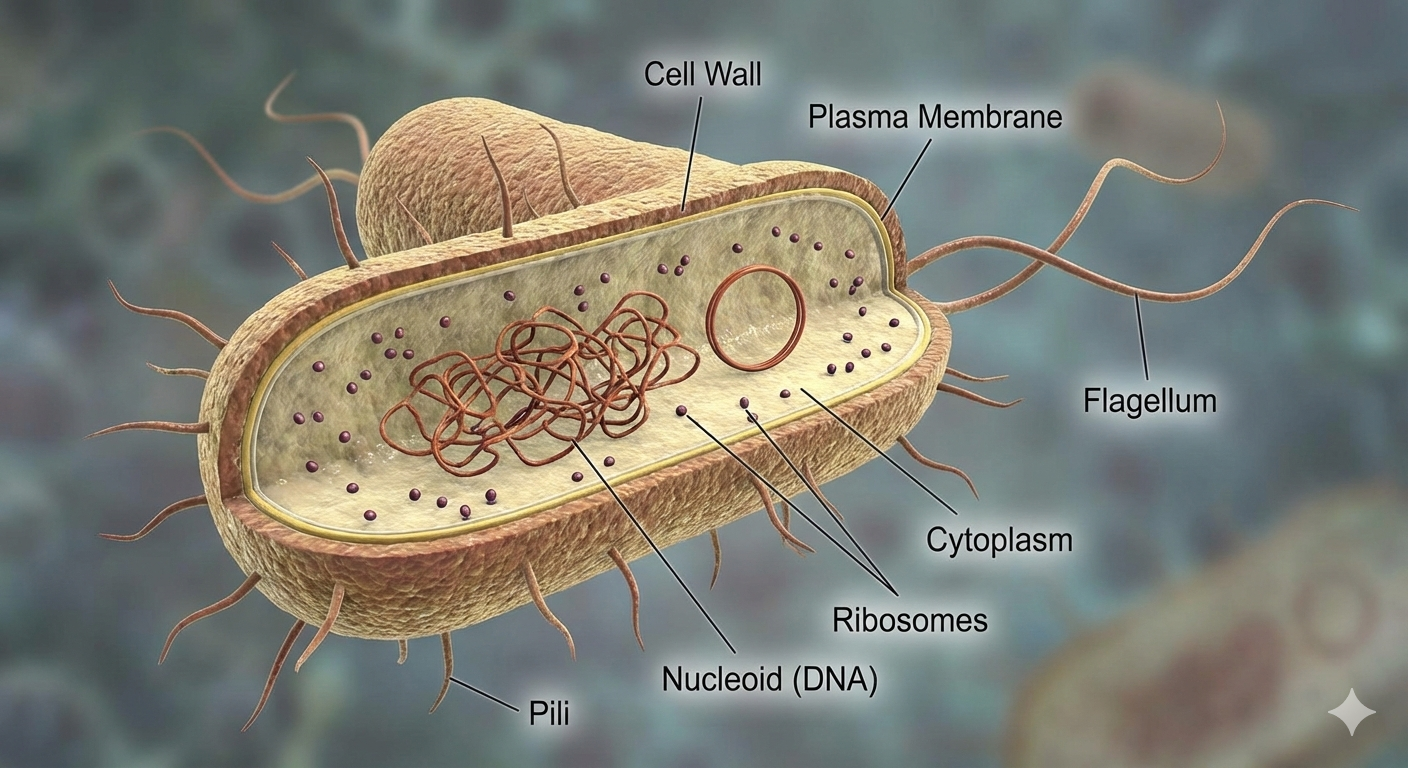
Bacteria are the most abundant form of life on Earth.
Eukaryotic
The first known eukaryotic organisms appeared only 1.5 billion years ago.
Eukaryotic cells are much larger than prokaryotic cells, with a diameter ranging between 10 μm and ~100 μm.
In addition to containing aqueous fluid (cytosol), the eukaryotic cytoplasm also includes inner compartments (organelles) that specialize in carrying out distinct cellular processes.
These cells contained basic inner compartments, which were formed by infolding of intracellular membranes into hollow bodies.
These compartments developed into the nucleus, ER, and Golgi apparatus.
Nucleus, ER, and Golgi apparatus
Nucleus
The nucleus is the organelle containing the cell’s genetic material. A region in the nucleus called the nucleolus specializes in constructing some of the cell’s biosynthetic machinery.
Endoplasmic reticulum
The endoplasmic reticulum (ER), a closed membranous structure extending from the nucleus towards the periphery, is responsible for the synthesis and modification of membrane proteins as well as of proteins destined for secretion or for other organelles.
Protein synthesis and modification take place in a region of the ER termed the ‘rough endoplasmic reticulum’ (rER).
As the major biosynthetic center of the cell, the ER is also responsible for building most of the cell’s lipids. This process takes place in a different region of the ER, termed the ’smooth endoplasmic reticulum’ (sER).
Golgi apparatus
The Golgi apparatus is a collection of membranous sacs near the periphery of the cell. It receives lipids and proteins from the ER and sorts them for distribution to different cellular locations, as well as for secretion.
Mitochondria and Chloroplasts
Mitochondria and chloroplasts emerged later, and both originated from ancient bacteria capable of oxidative metabolism and photosynthesis (respectively), and internalized by primitive eukaryotic cells (the endosymbiotic theory).
According to this theory, these bacteria somehow escaped digestion by the host cell, and over the eons gradually lost their independent characteristics. Thus, they turned into cellular organelles that are dependent on the host, but still capable of carrying out their ancestors’ principal metabolic functions.
Mitochondria
Mitochondria are the cell’s power stations, extracting chemical energy from food and storing it as accessible energy currency (ATP).
Vesicles
In addition to the larger and more complex organelles, eukaryotic cells also contain vesicles of different kinds, which perform various functions.
For example, lysosomes function as waste disposal units; they contain hydrolytic (i.e., degrading) enzymes that decompose outdated molecules, organelles, and chemicals that have penetrated the cell.
Another type of vesicle, the peroxisome, contains oxidizing enzymes. The oxidation acts on different molecules for different reasons, e.g., the neutralization of drugs and toxins.
Finally, transport vesicles allow the cell to transfer proteins and lipids between the different organelles, to integrate certain proteins within the plasma membrane, to externalize other proteins (exocytosis), and to internalize extracellular proteins (endocytosis and phagocytosis).
Plant Cells
Plant cells have several additional features, which are absent in animal cells.
Cell Wall
The cell wall of a plant cell resides peripherally to the plasma membrane and provides mechanical support to the cell.
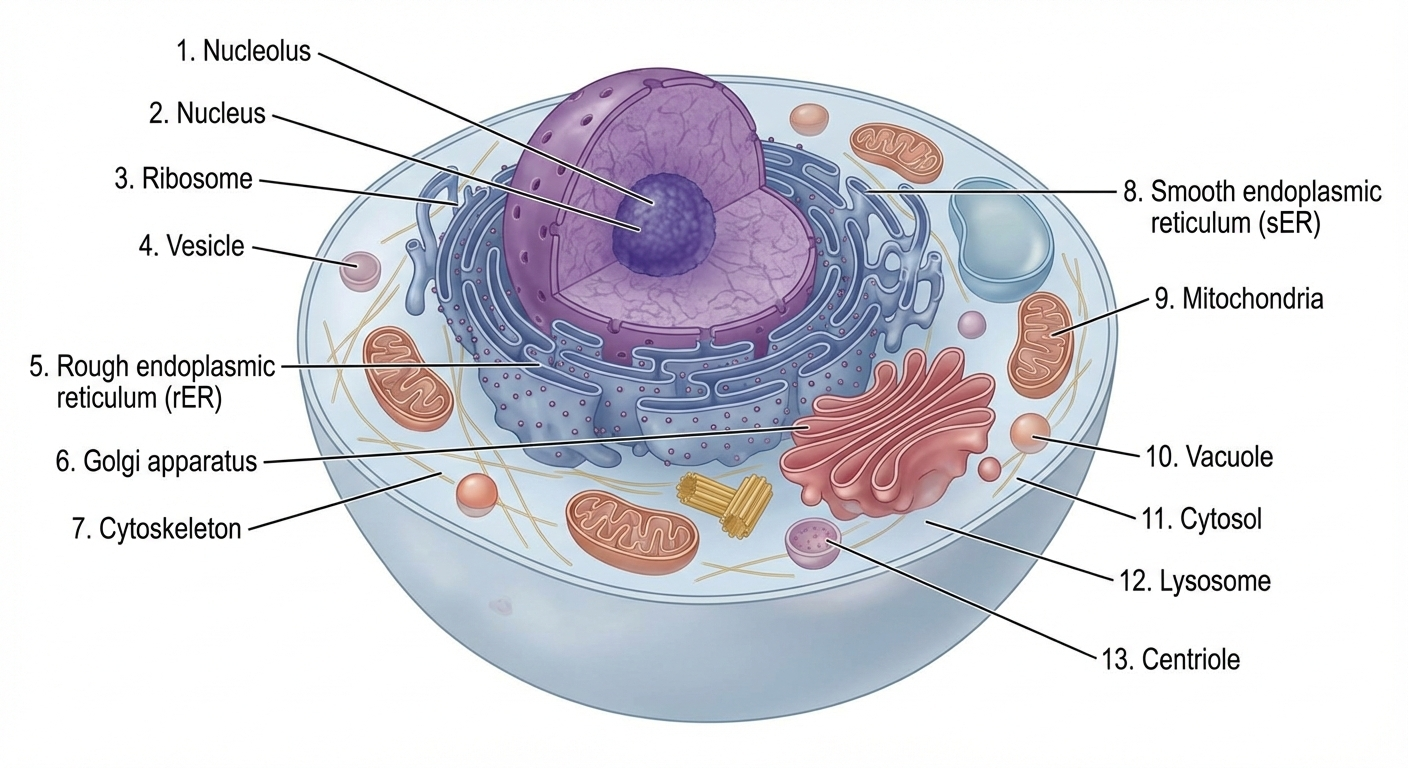
Vacuole
The vacuole plays several roles:
- Stores nutrients, waste products, and pigments.
- Participates in the degradation of cellular components.
- Regulates cell size, pH, and turgor pressure.
Chloroplasts
Chloroplasts, which are also present in algae, perform photosynthesis, a highly complex process in which solar energy is harnessed for the synthesis of carbohydrates from atmospheric CO2.
In other words, chloroplasts convert inorganic carbon into organic form.
In doing so, plants and algae supply fuel and building blocks for higher organisms, such as fish, insects, reptiles, birds, and mammals.
Multicellular
Unicellular organisms populated the Earth exclusively until about 1 billion years ago, when the first simple multicellular organisms started to appear.
Approximately 600 million years in the past, there was a rapid increase in the variety of sophisticated multicellular organisms.
The precise cause of this event, known as the ‘Cambrian explosion’¡, remains unknown and is subject to ongoing theories. However, at roughly the same time, the atmosphere oxygen levels reached their maximum, and it is assumed that the two events are connected.
That is, because complex multicellular organisms consume large quantities of oxygen, they were not able to form until oxygen levels in the atmosphere reached a certain threshold value. In any case, this occurrence started a chain of events, which finally led to the formation of tissues and organs in higher organisms.
Macromolecules
Given that living organisms are made of the same atoms as inanimate matter, it may seem strange that cells are chemically unique. Indeed, carbon, hydrogen, oxygen, nitrogen, and sulfur, which are the common atoms of living tissues, all come from either the crust or atmosphere of our planet.
However, there is a difference between chemical composition and molecular composition.
That is, the uniqueness of biological cells is not expressed in their atomic composition, but rather in the way these atoms are organized in the form of molecules. Whereas the cells’ inanimate environment is made of simple molecules such as water (H2O), gases (O2, N2, CO2), metals, and minerals, cells include, in addition to the above, complex molecules.
In particular, cells are rich in highly complex molecules termed macromolecules, which may contain thousands to millions of atoms.
As we will see later, macromolecules are built from basic organic building blocks, all of which have unique properties that make the existence of macromolecules (and life) possible — the tendency to self-assemble. That is, these small organic molecules tend to chemically react and physically interact with each other to form larger and more complex molecules.
There are three types of macromolecules: proteins, nucleic acids, and carbohydrates
These are responsible for the most basic aspects of life processes.
-
Nucleic acids, i.e., DNA and RNA, function in the encoding and expression of the cell’s own genetic information.
-
Complex carbohydrates function as energy stores in animals (glycogen) and plants (starch); as constituents of the cell wall in plants (cellulose) and of the exoskeleton of insects (chitin); and as a sophisticated means of molecular recognition.
-
Proteins also play a variety of important roles in cells and tissues, and their unique properties distinguish them from nucleic acids, lipids, and carbohydrates
Estàs llegint una vista prèvia.
Inicia sessió amb Google per llegir la pàgina completa.
Inicia sessió amb GoogleEncara no has enllaçat el compte? Entra un cop a l'Escola amb el Moodle del centre.